
Why Decluttering Feels So Hard (And the Decision Path That Changes Everything)

Why does decluttering feel so hard? Discover the decision-making mindset that helps women in midlife simplify their homes with clarity and confidence.

Most people imagine decluttering as a straightforward task. You walk through your house with a trash bag, toss out what you don’t need, drop a few boxes at a donation center, and by the end of the day everything feels lighter. Simple. Efficient. Done.
But for many women—especially in midlife—that’s not how decluttering actually unfolds. Instead, something unexpected happens.
You pick up an item and pause. You start thinking, "I used to use this all the time. What if I need it later? Maybe I’ll get back to that someday." Suddenly the process slows down. Decisions feel heavier. And before long, a quiet question appears: “Why is this so hard for me?”
Many women assume the answer is personal. They believe they must be too sentimental, too indecisive, or too attached to their belongings. But the truth is something very different.
Decluttering feels hard because it isn’t really about getting rid of things. It's about making decisions. And decisions about our belongings often carry far more meaning than we expect.
In this article, we’ll explore why decluttering can feel surprisingly difficult—and how understanding the Decluttering Decision Path can completely change the way you approach it.
The Real Problem: Why Decluttering Feels So Difficult
The biggest misunderstanding about decluttering is surprisingly simple. Most people believe decluttering is a physical activity. Fill a bag. Create a donation pile. Remove what you don’t use.
But this definition skips over the hardest part of the process. Decluttering is actually a decision-making process.
Every item in your home quietly asks a question: Does this still belong in my life?
That question may seem simple on the surface, but it often opens several deeper layers.
An object might represent:
A hobby you once loved.
A role you once had.
Money you invested.
A project you meant to complete.
A version of yourself you once expected to become.
When those thoughts appear, many women assume something has gone wrong.
They think decluttering should feel quick and easy. But hesitation isn’t failure. Hesitation means a real decision is happening.
And real decisions deserve attention.
When the Definition of Clutter Changes
During one decluttering presentation I gave, a woman in the audience shared something that many people quietly experience. She explained that she knew she probably had more things than she needed at this stage of life.
But the items in her home weren’t junk. They were good things. Quality things. Useful things.
One example she mentioned was her dining table. Years earlier, her home had been full—family meals, gatherings, people sitting around that table. At that time, the large table and chairs made perfect sense. But life had changed.
Now the table was far larger than she needed. Still, she struggled to see it as clutter. Because to her, clutter meant:
Broken items
Trash
Things with no value
So, I offered a different way to think about it.
Clutter is not junk.
Clutter is anything that no longer supports the life you’re living now.
In that moment, something shifted. The table wasn’t wasteful. It wasn’t wrong. It simply belonged to a different season of life. That change in perspective—moving from evaluating objects to evaluating life fit—is where meaningful decluttering begins.
Why Most Decluttering Attempts Lead to Overwhelm
This is also the point where many women become stuck.
Because the way most people attempt decluttering actually makes the process harder. They decide it’s time to declutter.
So, they empty a closet. Pull everything out of a drawer. Clear the entire kitchen counter. Suddenly they are surrounded by objects. Lots of objects. Each one asking for a decision.
Now the mental weight multiplies.
There are things you once used. Things you thought you would use. Things that are still perfectly good. Things you paid good money for. And another thought appears:
If I keep this… I should really use it.
The pressure grows. Soon there are piles. Maybe piles. Boxes labeled “decide later.” You move to another room hoping it will feel easier there. But the same hesitation appears again.
Eventually, many women stop. Not because they lack motivation. Not because they don’t care. But because they are facing too many decisions at once without a clear structure to guide them.
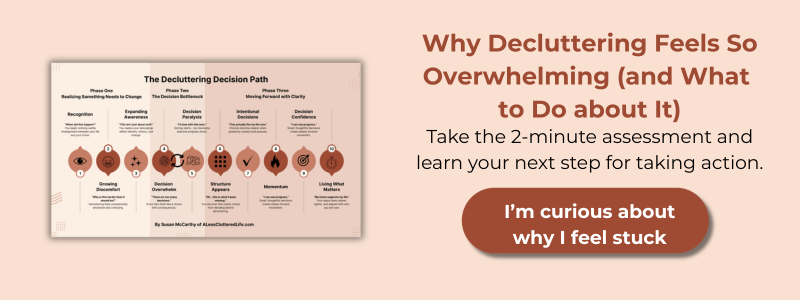
The Decluttering Decision Path
Once you understand this, something important becomes clear: Decluttering isn’t random.
Most people move through a predictable thinking process I call The Decluttering Decision Path. This path describes the journey many women experience as they move from postponed decisions to confident ones. It often includes stages like:
Recognition
You begin noticing subtle signs that something in your home feels misaligned.
Growing Discomfort
You start decluttering and realize it feels harder than expected.
Expanding Awareness
You recognize that your belongings reflect earlier versions of yourself.
Decision Overwhelm
Every object raises questions about usefulness, money spent, or possible regret.
Decision Paralysis
Sorting starts, but decisions stall. “Maybe” piles appear.
Structure Appears
You realize the real problem was never motivation—it was trying to decide without a clear framework.
Intentional Decisions
Choices become easier when they’re guided by your life rather than rules.
Momentum
Small decisions begin adding up and progress becomes visible.
Decision Confidence
You trust your judgment and feel less emotionally drained by the process.
Living What Matters
Your home begins to support the life you're actually living today.
Understanding this journey often brings immediate relief. Because suddenly the struggle makes sense. You’re not failing.
You’re simply moving through a normal decision-making process.
A Better Way to Approach Decluttering
The turning point happens when women stop trying to declutter randomly. Instead, they begin making decisions based on their lives. Not rules. Not checklists. Not someone else’s philosophy about minimalism.
Instead, they ask a different question: Does this support the life I’m living now?
When decisions come from that perspective, many things become clearer.
Past hobbies.
Projects that once mattered.
Activities that once fit your schedule but no longer do.
Letting those things go doesn’t feel like deprivation. It feels like honesty. It feels like acknowledging that life moves forward.
Confidence Grows Through Decisions
Something else happens as this process continues.
Confidence grows. Not because decluttering suddenly becomes effortless. But because you begin trusting your own judgment.
Instead of relying on rules like: “If you haven’t used it in a year, get rid of it.” You start evaluating your life. Your routines. Your interests. Your priorities.
You recognize that letting go of something from a past season doesn’t erase that season. It simply acknowledges that life has changed. And with each decision, something opens up. More physical space. More mental space. More energy. More room for what matters now.
Why Decluttering Becomes So Important in Midlife
For many women in their 50s and 60s, life is already shifting. Children leave home. Parents age. Retirement approaches. Health becomes more important. New questions begin to appear.
How do I want to spend my time?
What matters most now?
What do I want the next chapter of life to look like?
But the home often still reflects earlier decades. Past responsibilities. Past expectations. Past roles. And that’s where a quiet tension appears.
The deeper desire isn’t just a tidy house. It’s the desire not to feel stuck in the past.
Decluttering becomes a way of allowing your home to catch up with the life you’re living now.
Your First Step
If you recognize yourself somewhere on the Decluttering Decision Path, there is a simple place to begin.
Instead of asking: “What should I get rid of?” Ask a different question. Imagine an ordinary day in your life. Not a vacation. Not a perfect version of life. Just a normal Tuesday.
Ask yourself:
Who do I spend time with now?
What activities fill my days?
What interests matter most to me today?
Those answers reveal something powerful. The things that support that life belong. The things that don’t? They’re simply reminders of past seasons.
And that’s okay.
You don’t have to rush. You don’t have to do everything at once. Just start making decisions. One item. One drawer. One small space at a time. Because this is where postponing ends. And this is where your home begins to support the life you’re living now.


Comments