
Three Questions to Ask Before You Declutter a Past Identity: When your Past Identity Keeps You Stuck

Learn why past identities can make decluttering difficult — and how to honor who you were while deciding what truly belongs in your life now.


Have you ever picked up something while decluttering and thought, I know I don’t use this anymore. I know this doesn’t fit my life now. So why can’t I let it go?
Maybe it’s something from the career you retired from. Equipment from a hobby you once loved. Clothes from a time when your body or your life looked very different. Something connected to a relationship that ended.
Or supplies for something you were absolutely convinced you were going to do someday.
You know the item isn’t part of your life now. But when you think about letting it go, something stops you. That’s when it’s easy to get frustrated with yourself. Why am I making such a big deal about this? Why can’t I just get rid of it?
But sometimes the decision you’re struggling with isn’t really about the possession. It’s about who you were when that possession mattered. Or who you thought you were going to become. And understanding that can change the way you approach the decision.
When Decluttering Becomes Decision Paralysis
There’s a point in decluttering when you’ve started sorting, but the decisions begin to stall. Maybe piles appear. Boxes get labeled so you can decide later. You move to another room because you’re hoping the decisions will be easier there. Or you start organizing everything because at least that feels productive.
This is Decision Paralysis, Stage 5 of the Decluttering Decision Path. And possessions connected to your identity can make this stage particularly difficult.
You may think you’re trying to decide whether to keep old binders from your career. But maybe you’re really trying to figure out how you feel about no longer being the professional woman who attended those conferences, took those notes, and did work that mattered to her.
You may think you’re deciding whether to keep sports equipment. But perhaps your health has changed, and letting go means acknowledging that an activity that once played an important role in your life no longer does.
Or maybe you’re looking at boxes of craft supplies for something you were convinced you’d do someday. You were going to become a quilter. Learn to paint. Restore furniture. Take up photography. And someday never came.
These aren’t always simple decisions about possessions. Sometimes the belongings represent an identity that ended naturally. Sometimes they represent something that ended painfully. And sometimes they represent an identity you never got to experience at all.
So when you hear yourself thinking, I’ll deal with this later, consider another possibility. Maybe what you’re really saying is: I’m not ready to acknowledge what this decision would make real.
That doesn’t automatically mean you should keep the possessions. And it doesn’t mean you should get rid of them. It means there may be another decision that needs to happen first.

Honoring Your Past Isn’t the Same as Preserving It
There’s an important distinction between honoring your past and preserving it. Nostalgia isn’t a bad thing. You can look back fondly on an earlier version of yourself. You can miss her. You can be proud of her. You can wish you could experience part of that life again.
There may also be grief involved. A relationship ended. Your health changed. You retired from a career that had been an important part of your identity. Your children grew up and left home. Or life simply went in a different direction from the one you expected.
You don’t have to pretend those things don’t matter just so you can get through a decluttering project. But honoring a past identity isn’t the same as preserving everything connected to it.
When you honor something, you can be selective. Maybe your career meant a great deal to you. You could frame a few photographs along with an award or certificate you’re particularly proud of. You might choose a couple of meaningful objects and put them somewhere you’ll actually see them. You aren’t trying to recreate your entire office. You’re choosing the things that tell the story you want to remember.
Preservation is different. Preservation says nothing can change. Every binder stays. Every conference tote bag stays. Every old file stays. Everything connected to that part of your life remains because letting go of any of it feels like letting go of part of yourself.
But is keeping something in a box actually honoring it? That’s a different question.
The Badminton Set I Couldn't Understand
Years ago, I offered to help declutter my parents’ basement. There was a lot of stuff down there. It was difficult to move around the piles. My father immediately told me to stay away from his tools and his things. My mother told me I couldn’t get rid of anything without showing it to her first.
Her health was poor, so she wasn’t going up and down the basement stairs. Instead, she sat in a chair in the kitchen while I brought things upstairs. Early in the process, I found our old badminton set. It was in terrible condition.
Both racquets were held together with tape. The net had holes in it and knots everywhere from years of attempts to repair it. As I walked past my mother, I announced that it was broken. She told me to bring it back.
I pointed out the damage. She told me to put the badminton set back in the basement.
“It's junk. Why keep it?” I asked.
“The grandchildren can play with it,” she said.
“But, Mom, you don’t have grandchildren.”
“When I do, they can play with this. Put it back.”
I was nearing 40 at the time. I knew I wasn’t going to have children. Neither was my brother. I got upset. And the experience essentially ended my offer to organize their basement.
At the time, I thought the lesson was simple: My parents aren’t going to let go of anything. Today, I see something very different. First, I saw all that stuff as clutter. My parents didn’t.
That was my perspective, not theirs. And the decisions weren’t mine to make. Knowing what I know now, I wouldn’t have gone into that basement assuming I could identify what my parents no longer needed. I might have asked my mother: “Can you think of anything down there that you know you no longer need?”
Because she had to recognize that something no longer belonged before there was a decision to make. But there was another lesson in that badminton set. My mother wasn’t really preserving two broken racquets and a damaged net. She was preserving an imagined future. In that future, she was a grandmother. Her grandchildren were going to come to her house. And they were going to play with those toys.
Within that story, keeping the badminton set made sense. Letting it go might have required acknowledging that the imagined future wasn’t going to happen. And she wasn’t ready to do that.
Why “Just Get Rid of It” Can Backfire
This is one place where conventional decluttering advice can fail us. Rules seem useful because they eliminate the decision. If you haven’t used it in three months, get rid of it. Or six months.Or a year.
But what’s the right number? More importantly, what happens when the possession represents something much bigger than the last time you used it?
You can force yourself to get rid of something before you understand whether that’s actually the decision you want to make. Then you’re left with doubt.Maybe you made the decision because you thought you were supposed to. You were decluttering. Decluttering means getting rid of things. Therefore, this thing had to go.
Maybe someone else pressured you. Maybe you were working under a deadline. Maybe you followed somebody else’s rule. Technically, you made a decision. But it didn’t feel like your decision. That matters.
Imagine you already struggle to let go because you’re afraid you’ll regret it. One day, you get frustrated and force yourself to get rid of a large number of things. Later, you regret one of those decisions. What have you taught yourself?
See? I knew it. I shouldn't get rid of things. I can't trust myself to make these decisions. Now you’re even more hesitant the next time you declutter. The attempt to eliminate Decision Paralysis has actually reinforced it.
The answer to Decision Paralysis isn’t necessarily faster decisions. It’s clearer decisions.
Are You Organizing a Decision You Haven't Made?
There’s another way postponed decisions hide in our homes. We organize them. We buy bins. We label them. We sort everything neatly. Then we find a place in the basement, attic, closet, or garage. It feels like progress.
But sometimes organizing a postponed decision simply makes it look like a decision has been made. And there’s another problem. Once you’ve invested in storing those possessions, the investment itself can make them seem more important. You bought the bins. You spent Saturday sorting. You labeled everything. You found room for it. Maybe you’ve moved those boxes from one house to another.
You’ve invested time, money, energy, and space. Eventually, all of that effort can create an aura of importance around whatever is inside. Of course these things matter. Look at everything I’ve done to preserve them. So before you buy another storage bin for possessions connected to an earlier version of yourself, stop. Don’t ask how you’re going to store them. Ask what you’re actually preserving.
Step Away From the Item
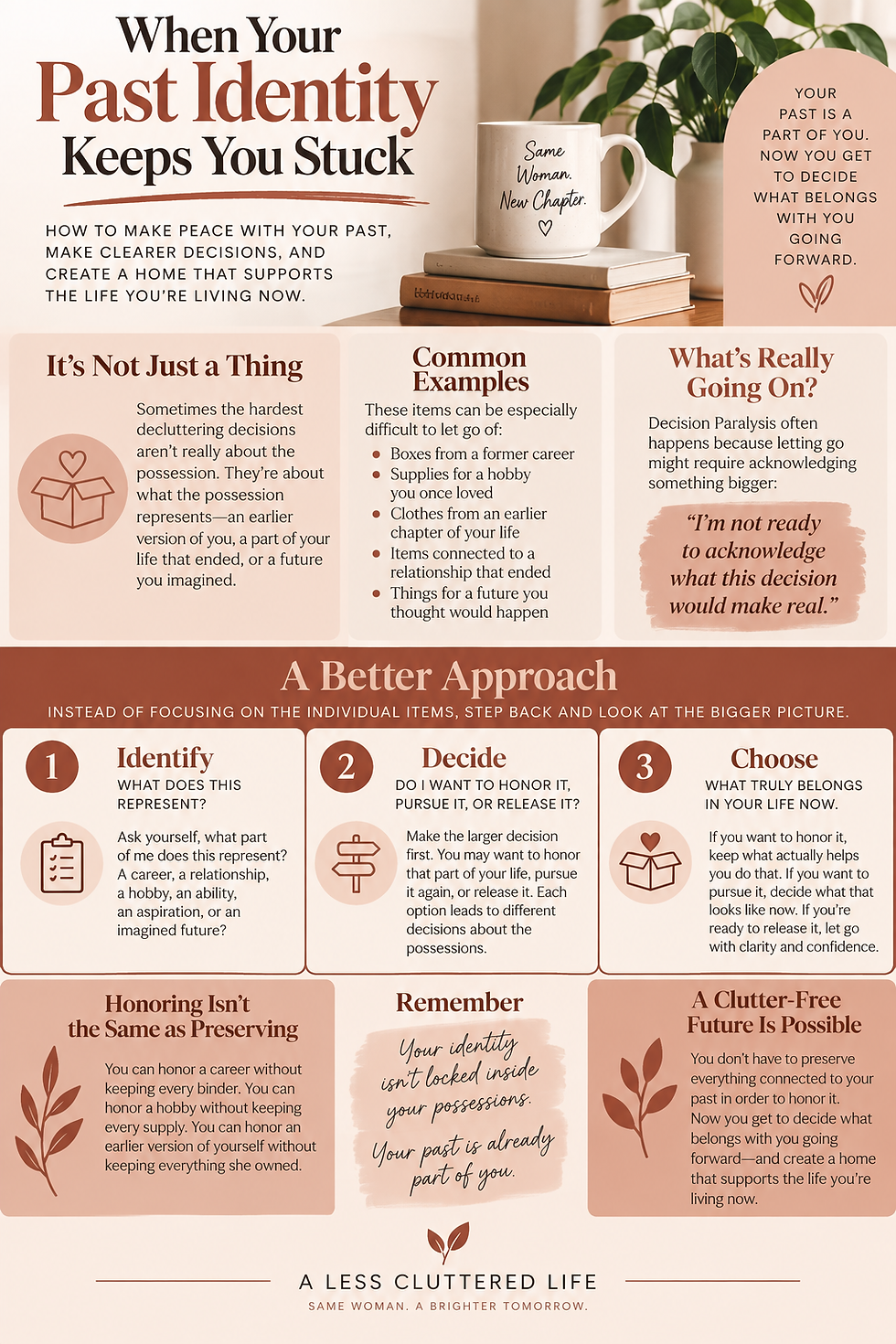
If you have six boxes connected to a former career, deciding binder by binder probably won’t give you the clarity you need. Step away from the individual items. Look at the larger context. Ask yourself: What makes these possessions important to me? How do I hope to use them? When am I realistically going to do that?
Then go deeper. Is this part of my life something I want to actively honor? Is it something I still want to pursue? Or is it something that has ended?
If it’s an aspiration, ask whether it’s something you still want — and realistically can — work toward. The answer may be yes. Good. Now you know something important. But the answer may also be no.
And there may be grief in that answer. Grief for something that never happened. Grief for a woman you thought you’d become. You don’t have to respond to that realization by immediately filling a donation box. Sit with the thought. Notice what you’ve recognized. Maybe simply understanding why you’ve been unable to decide brings some relief.
Oh. That's why I couldn't decide. Or perhaps you realize you need more time. That’s useful information, too. The goal isn’t to rush through the feeling so you can get back to decluttering. The goal is to understand the context in which you’re making the decision.
Acknowledge What That Part of Your Life Gave You
Gratitude can be useful here — not as a trick to convince yourself to get rid of something, but as a way to recognize what that part of your life actually gave you.
Maybe you had a hobby you no longer do. What did you receive from it? Joy? Learning? Relaxation? Friendships? Maybe you had a long career. What did that career give you? Experiences. Skills. Relationships. Challenges you overcame. Stories you still tell. Those things don’t live in the binders filled with workshop notes.
They’re part of you.
The same can be true of an aspirational identity. Maybe you bought the supplies. You signed up for the class. You imagined yourself doing this thing. And then you didn’t.
Instead of looking at those possessions and thinking, What a waste. I can't believe I never did this, acknowledge the woman who had that aspiration. She was interested. She was curious. She thought this might matter to her. Then other things mattered more. You directed your attention elsewhere. That doesn’t necessarily mean you failed. It means you made other choices. And acknowledging that may allow you to see the possessions differently.
Your Identity Isn't Locked Inside Your Possessions
This is what I want you to remember when decluttering possessions connected to your past: Your identity is part of you. It isn’t locked inside your possessions. You are the woman you are today because of everything that came before. The hobbies. The jobs. The relationships. The activities. The aspirations. The successes. The things that didn’t turn out the way you thought they would.
All of those experiences contributed something to the woman you are now. You don’t lose them because you let go of an object. You can honor the woman you were without keeping everything she owned. You can honor a career without keeping every piece of paper connected to it. You can honor a hobby without keeping every supply. And you can honor the woman you hoped to become without maintaining a physical inventory of the life she imagined.
Some parts of your past may deserve to remain visible in your home. Choose the photograph. Frame the certificate. Display the award. Put the meaningful object on the shelf. Tell the story. But make that a decision. Not a default.
Three Questions to Ask Before You Declutter a Past Identity
If you’re looking at a closet, collection, or stack of boxes connected to an earlier version of yourself, don’t begin with: What should I get rid of? Start with: What part of me does this represent? Then ask: Do I want to honor it, pursue it, or release it? And finally: What possessions, if any, actually support that decision?
You don’t have to rush the answer. But don’t hide the question in another storage bin either.
Your home doesn’t have to preserve every version of you in order to honor the woman you’ve become. Your past is already part of you. Now you get to decide what belongs with you going forward. This is where postponing ends.
Recap of Decluttering a Past Identity
Why is it so hard to get rid of things from my past? Sometimes possessions represent more than their practical use. They can be connected to a former role, relationship, hobby, ability, aspiration, or imagined future. Before deciding what to do with the object, it may help to identify what part of your identity it represents.
How do I declutter sentimental items without regretting it? Don't begin by forcing yourself to make faster decisions. First understand why the possessions matter and what you want them to represent in your life now. You may decide to keep a small number of meaningful objects, display them intentionally, or let go of items that no longer contribute to the story you want to carry forward.
What if I'm not ready to let go? Recognizing that you're not ready can be useful if you also understand why. The important distinction is between intentionally taking more time with a meaningful decision and automatically postponing it because you don't want to face the question.
Does letting go of possessions mean letting go of my past? No. Your experiences, relationships, accomplishments, interests, and choices have already shaped who you are. An object can remind you of that history, but it doesn't contain it. You can choose which possessions genuinely help you honor your past without preserving everything associated with it.



Comments