
Why You Don’t Need a Full Day to Declutter (And What Actually Works Instead)


Most women believe decluttering requires a full day. A clear schedule. Energy they don’t have.
So, they wait. And while they wait… nothing changes.
But here’s what’s actually happening: Even a full day of decluttering is not one action. It’s a series of small decisions—linked together. And when you understand that you stop waiting—and start moving.
The Real Reason You Haven’t Started
It’s easy to assume the problem is time.
You tell yourself you need a full day because anything less feels incomplete. If you can’t finish the room, what’s the point of starting? That logic feels reasonable on the surface—but it quietly keeps you stuck. Because the issue isn’t your schedule.
It’s how you’ve defined progress.
When progress only “counts” if a space is fully done, you create an all-or-nothing threshold. And anything that doesn’t meet that threshold gets postponed. Not rejected—just delayed indefinitely.
What Actually Happens When You Try to “Do the Whole Room”
Most women don’t realize they are stepping into a predictable pattern.
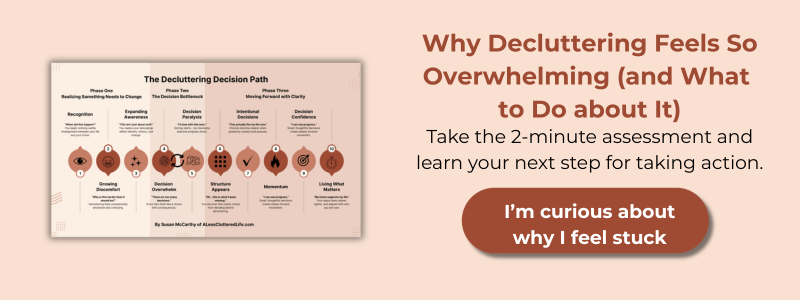
It starts simply enough. You walk into a room and notice what’s off. That’s the Recognition stage of the Decluttering Decision Path —the moment you see that your space no longer reflects your life now.
So, you decide to fix it. But the moment you begin, something shifts. You open a drawer. Then a cabinet. Then a shelf. And suddenly, what looked manageable feels heavier. Decisions you thought would be easy start to feel uncertain.
This is stage 2 - Growing Discomfort. You hesitate over items you haven’t used in years. You wonder why this feels harder than it should. You start to feel the weight of deciding—not just sorting. And without realizing it, you’ve already moved deeper into the process.
When Decluttering Stops Being About “Stuff”
As you continue, another shift happens. You begin to see that these aren’t just objects. They represent past projects, earlier roles, interests you once had, and possibilities you thought you might return to.
This is stage 3 - Expanding Awareness.
At this stage, generic advice stops working. “Just get rid of what you don’t use” feels too simplistic, because the decisions don’t feel simple. They feel personal. You’re no longer just asking, “Do I need this?” You’re asking, “What does this say about me… and am I ready to let that version of me go?”
Why the “Full Day” Approach Leads to Overwhelm
If you keep pushing forward without a clear decision structure, the mental load increases.
Now you’re surrounded by items that are:
Useful, but not used
Meaningful, but not current
Valuable, but not relevant
Every object carries a question. What if I need this later? Should I keep it because it’s good quality? Will I regret letting this go? This is stage 4 of the Decluttering Decision Path - Decision Overwhelm. And this is where most decluttering efforts break down.
Because it’s not the volume of stuff that’s overwhelming. It’s the pressure to make good decisions—over and over again—without a framework to support you.
What Happens Next (And Why You Feel Stuck)
At this point, something has to give. So, you start creating “maybe” piles. You put things in bins to revisit later. You move items instead of deciding about them. This is stage 5 - Decision Paralysis.
From the outside, it can look like progress. The space may even look more organized. But the real work—the decisions—has been postponed. And this is where a deeper cost shows up. You begin to reinforce the belief that you don’t follow through. Not because you’re incapable. But because the structure you’re using makes follow-through difficult.
The Insight That Changes Everything
Here’s what most women miss: Even when you imagine having a full day to declutter…you are not doing one big task. You are making a series of small decisions. One drawer. One shelf. One surface. That’s what the work actually consists of.
The only difference is that you’ve grouped those decisions into a longer block of time—and labeled it “decluttering the room.” But the work itself hasn’t changed.
The Reframe: Linked Little Spaces
If decluttering is already happening one small space at a time… Then you don’t need the full day. You can take the exact same process and spread it across your real life. Instead of: “I’m going to declutter this room.” You decide:“ I’m going to finish this one space.” A drawer. A shelf. A flat surface. You complete it fully. Then you choose the next.
This is what allows you to move forward without triggering overwhelm.
Why This Method Works (Behaviorally and Practically)
This approach works because it aligns with how decisions are actually made. When you limit the scope to one defined space, you reduce cognitive load. You’re no longer managing dozens of decisions at once—you’re focusing on a contained set. That alone changes how the process feels.
But something else happens too. You finish.
And completion matters.
Because completion creates a closed loop in your brain. It signals that something has been resolved. And that resolution creates a sense of satisfaction that motivates you to continue. This is how momentum builds—not from intensity, but from completion.
The Early Win That Most Women Overlook
Most women believe they’ll feel better when the room is done and decluttering. But that’s not where the shift happens. It happens much earlier. It happens when you finish a drawer.
That moment—small as it seems—is where confidence starts to build. Because now you have evidence. Not intention. Not plans. Proof. “I finished this.”
And when that experience repeats, something changes internally. You stop wondering if you can do this.
You start trusting that you can.
What This Looks Like in Real Life
This is exactly what one woman discovered when she stopped waiting for a full day. She had avoided decluttering for months because she knew what would happen. She would start, get tired, and then avoid making decisions about what she had pulled out.
So, she didn’t begin.
When she shifted to one small space, the experience changed. She chose a drawer. She finished it. Then another. A few weeks later, she had cleared multiple areas that had been bothering her for years. Not in one burst of effort—but through steady, completed decisions.
She didn’t wait for motivation. She built momentum.
How to Start Decluttering (Without Overthinking It)
Start here: Choose one small space.
Not the whole room. Not the most overwhelming area. One drawer. One shelf. Finish it completely. Then decide the next.
This Is How You Move Forward
Decluttering is not a time problem. It’s a decision structure problem. When you stop treating a room like a single task, and start treating it as a series of completed decisions, everything changes.
You move out of overwhelm. You stay out of paralysis. You begin building momentum. And over time, something even more important happens: You rebuild trust in your ability to decide.
This is how momentum is built. This is how confidence is earned. This is how your home begins to reflect your life now.
This is where postponing ends.


Comments