
Why Decluttering Starts with Noticing, Not Sorting: The Mistake Most People Make When They Start Decluttering

Decluttering does NOT start with grabbing a trash bag or emptying a closet or room. This is where you need to start before you touch a single item.


Most people think decluttering begins with trash bags and cardboard boxes. You see a space that looks mess. So, you assume the solution is to start removing things.
You gather containers. You start sorting. You move quickly from one item to the next. But this approach skips the most important step. Decluttering does not begin with sorting. It begins with noticing.
Because if you don’t understand what you’re seeing in your home, you won’t know what actually needs to change. This is why so many decluttering attempts stall. Women start working before they understand the problem.
And when the problem isn’t clear, every decision feels harder than it should.
The Feeling That Starts the Decluttering Process
The beginning of decluttering rarely looks dramatic. Most homes that feel cluttered don’t look chaotic. They look… fine.
The rooms function. The shelves hold things. The closet doors close. But something feels heavier than it used to.
You might notice small signals:
The guest room slowly becoming a storage room
Digging through piles of paper to find one document
A closet that used to feel manageable now feeling crowded
A room that looks tidy but still feels full
Nothing changed overnight. What changed is how you see the space. That moment, when you start noticing something feels off, is the real beginning of decluttering.
Why Sorting Too Soon Creates Frustration
When people feel that sense of “too much,” they often respond by jumping into action. They grab trash bags. They set up donation boxes. They start evaluating items one by one.
But this assumes the problem is already clear. Most of the time, it isn’t.
At the beginning of the decluttering process, women aren’t identifying specific items as clutter. They’re experiencing volume. The thought isn’t: “This sweater is clutter.” The thought is: “Why does this room suddenly feel heavier?”
Sorting too early forces decisions before clarity exists. And when clarity is missing, every item becomes harder to decide about.
Recognition Comes Before Action
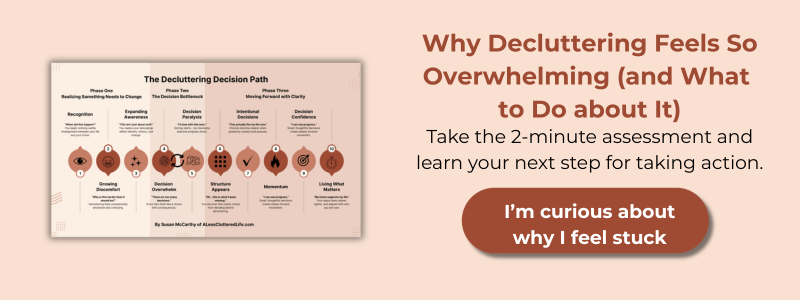
The first stage of decluttering is recognition. Recognition is the moment when you begin to see that your home may no longer reflect your life the way it once did.
Sometimes this realization arrives quietly. You walk into a room and think: “When did this happen?” You notice spaces filled with things connected to earlier seasons of your life. Past hobbies. Past responsibilities. Past expectations.
The home didn’t become cluttered overnight.
It simply continued holding things from versions of your life that have already moved on. Recognition is the moment you begin to see that.
Why Decluttering Can’t Be Forced
One of the clearest examples of recognition came from a woman I’ll call Ruth. A friend, Carrie, offered to help her declutter her living room. They sat together and began evaluating items in the space. But there was a problem.
Ruth didn’t believe she had clutter.
So, every item stayed. Even a dust-covered, partly burned Santa candle that Carrie clearly saw as trash. To Ruth, it belonged with the Christmas decorations. The session ended in frustration. Carrie was frustrated because Ruth wouldn't get rid of anything. Ruth was frustrated because Carrie wanted to toss her belongings.
Not because Ruth was incapable of decluttering. But because she had not yet reached the stage of recognition.
If someone hasn’t realized that something in their home no longer fits, every item feels defendable. Decluttering can’t begin until that shift happens.
The First Signal: “There’s Too Much”
When recognition begins, the thoughts are rarely specific. You don’t start by evaluating individual items. Instead, you notice a broader feeling - “There’s too much in here.”
This reaction matters. Your mind is recognizing a mismatch between two things:
the life you’re currently living
the belongings still filling your space
That awareness is the first step toward meaningful decisions. Without it, decluttering feels like guessing. With it, the path forward becomes clearer.
What To Do Instead of Sorting
When you first notice that sense of “too much,” resist the urge to start sorting.
Instead, pause. Choose one room. Then ask a different question: How do I actually use this space? Most rooms serve three basic purposes:
1 Activities: What happens here?
Examples might include:
sleeping
reading
exercising
working
relaxing
2 Display: What deserves to be visible?
These are the objects that represent meaning, identity, or memories you actively want present in your environment.
3 Storage: What needs to live in this room so the activities can happen easily?
This might include:
clothing
books
equipment
everyday supplies
Looking at a room through these three functions creates context. And context changes how decisions feel. Instead of evaluating objects randomly, you begin seeing what naturally belongs in the space, and what doesn’t.
Why This Step Creates Decision Clarity
When you understand how a room supports your life, decisions stop feeling arbitrary. You’re no longer asking: “Should I keep this?” You’re asking a different question: “Does this belong in the life I’m living now?”
That shift changes everything.
Decluttering becomes less about removing things and more about choosing what supports your life today. And once that clarity appears, the sorting process becomes far easier.
The Beginning of Real Decluttering
Decluttering doesn’t begin with throwing things away. It begins with noticing. Noticing when a room feels heavier than it should. Noticing when something in your home stops working. Noticing when your space reflects an earlier version of your life.
Sorting comes later. First comes recognition.
A Simple Place to Start Today
Today, don’t reach for a trash bag. Instead, choose one room. Stand in the doorway for a moment and look around. Then ask yourself a single question: How do I want this space to support my life now?
That question is where real decluttering begins.


Comments