
Why Structure Reduces Decluttering Regret (and Why You’ve Been Stuck Without It)

Decluttering feels overwhelming because you’re trying to decide without structure. Learn how to reduce decluttering regret, stop overthinking, and make clear, confident decisions—starting with one space.


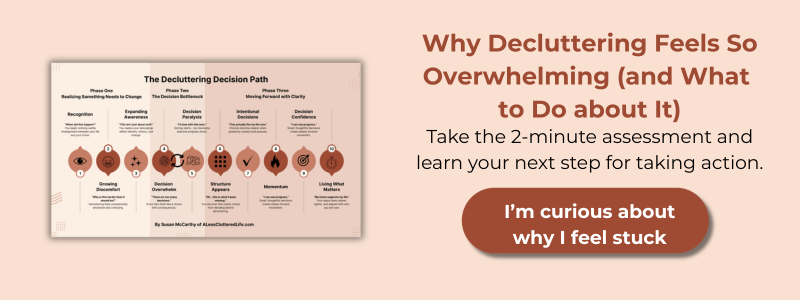
You think you’re afraid of letting things go. You’re not. You’re afraid of making the wrong decision. So, you hesitate. You overthink. You keep things “just in case.” And slowly, almost invisibly, your home fills with postponed decisions.
Not clutter. Not mess. Decisions you haven’t made yet.
This is where that changes. Because the problem isn’t your ability to declutter. It’s that you’ve been trying to decide without structure.
The Real Reason Decluttering Feels So Risky
Decluttering feels heavy when every item becomes a question with no clear answer.
You pick something up and ask:
Will I use this someday?
What if I need it?
What if I regret letting it go?
There’s no resolution to those questions. Only more thinking. So, you default to keeping it. Not because it belongs. Because it feels safer than deciding.
This is the part most decluttering advice misses. The problem isn’t the item. It’s the lack of a decision framework. Without structure, every object becomes a test of your judgment. And when everything feels important… nothing gets decided.
The Myth That Keeps You Stuck
There’s a quiet belief underneath all of this: “I need to be sure before I let something go.”
So, you try to create certainty. You analyze every possible future. You justify keeping things. You organize instead of decide. And it feels productive.
It isn’t.
Because the more you try to prepare for every possibility… the more decisions you avoid making. And that’s where the real regret builds. Not from letting something go. But from postponing decisions for years.
The Shift That Changes Everything
You are not trying to predict every future. You are choosing which future you’re preparing for. That’s a completely different role. One is reactive. The other is intentional. And that shift requires structure.
What Structure Actually Does
Structure answers the question before you pick up the item. Instead of asking: “Should I keep this?” You ask: “Does this belong in the life I’m actively living or preparing for?” Now the item is no longer judged in isolation.
It’s evaluated in context of:
Your routines
Your space
Your priorities
Your current season of life
This is the foundation of how you begin making clear decisions. Not by analyzing the object. By defining the life it’s meant to support. When that’s clear, many decisions make themselves.
The Turning Point: When Structure Appears
There’s a moment in this process where everything shifts. Not because your home changes first. Because your thinking does.
Lindsey experienced this in a way she didn’t expect. Her dining room had become a holding zone. Not because she didn’t care. Because she didn’t know how to decide.
She was circling the same questions:
What if I need this later?
What if I regret getting rid of it?
Should I keep it just in case?
So, nothing moved... until something changed. She took in a neighbor’s large dog during an emergency.
Suddenly, her home felt different.
More full. Less flexible. And that’s when clarity arrived. She realized: “I want my home to be ready.”
Ready for:
Guests
Unexpected situations
Real life
That became her structure. And the question changed. From: “Could I use this someday?” To: “Does this support being ready?”
She stopped trying to prepare for everything. She started defining what ready meant. And once that was clear… Her decisions followed. Still sometimes uncomfortable, but no longer confusing.
Why Decluttering Regret Decreases When Structure Is Present
Before structure:
Every item felt important.
Every decision felt risky.
Every possibility had to be considered.
Progress stalled.
After structure:
A specific version of the future is defined.
Items are filtered through that lens.
Decisions become faster.
Mental noise decreases.
The key shift is simple: From: “What if I need this?” To: “Does this support what I’ve chosen?”
You are no longer guessing. You are deciding from clarity. And that’s what reduces regret. Not perfect decisions. Clear ones.
A Simple Way to Introduce Structure Today
Start here... not with your stuff... with your life.
Ask yourself: “What do I want my home to make easier?” Be specific. Not “more organized.” Not “less cluttered.” Specific.
For example:
Cooking more meals → clear one section of your counter
Creating a craft space → define one corner
Hosting more often → prepare one usable area
Then shift to the space. Ask: “What belongs here — based on how I want to use it?”
Now you’re not decluttering randomly. You’re making decisions within context. This is where confidence begins.
How Decision Confidence Is Actually Built
Not through motivation. Not through big, dramatic clean-outs. Through repetition.
One defined space
One clear purpose.
One decision at a time.
This is how you move from hesitation… to clarity. From overthinking… to action. From postponing… to forward movement.
This Is Where Postponing Ends
You don’t need more decluttering tips. You need structure. Because structure:
Reduces mental noise.
Clarifies decisions.
Lowers regret.
And most importantly… It changes how you trust yourself. So, start small. Choose one space. Define what it’s for. And begin deciding from there. This is where postponing ends.
Takeaways from Reducing Decluttering Regret
If you feel overwhelmed when decluttering, chances are that it's because you’re trying to make decisions without a framework. Without structure, every item feels equally important and mentally exhausting.
If you're afraid of regretting letting go of items, stop trying to predict every possible future. Define the life you’re actually preparing for and make decisions based on that.
The first step to decluttering without overwhelm is to choose one small space and define its purpose. Then decide what belongs there based on how you want to use it. Remember, decluttering isn't about getting rid of things! It’s about making clear decisions. The removal of items is simply the result of those decisions.




Comments