
Why Confident Decision Makers Rarely Accumulate Clutter Again

Updated: Jun 4
Think clutter comes back because decluttering motivation fades? Discover why confident decision makers rarely accumulate clutter again - and how trusting yourself changes what enters your home in the first place.


Most people think clutter comes back because motivation disappears. I don’t think that’s true. I think clutter comes back when postponed decisions come back.
Because clutter rarely starts with overflowing drawers or closets packed too tightly. It starts much earlier. It starts when we keep possibilities open. When we postpone choices. When we quietly tell ourselves: "Maybe someday."
And if you've ever worried: "What if I declutter now and end up right back here five years from now?" You are not alone. Many women carry that fear quietly.
What if I regret letting something go? What if I need it later? What if I just buy it all over again?
Those questions make sense. But I think they point toward something deeper. Because the women who reach a place of lasting progress usually aren’t relying on stronger motivation or better organization systems. They've changed something more important. They've changed how they make decisions.
Why Clutter Returns
Most people assume clutter is caused by acquiring too much. But often clutter begins with postponed decisions. Items enter our homes because we imagine future possibilities:
Maybe I'll learn watercolor someday.
Maybe I'll start sewing again.
Maybe I'll finally read those books.
Maybe I'll have time after retirement.
The object itself isn't the issue. The issue is that possibility remains open. And open decisions tend to accumulate. That’s why clutter often feels heavier than it looks. Because you're not simply managing possessions. You're managing unresolved choices. Your home quietly becomes storage for postponed decisions.
Decision Confidence Changes More Than Decluttering
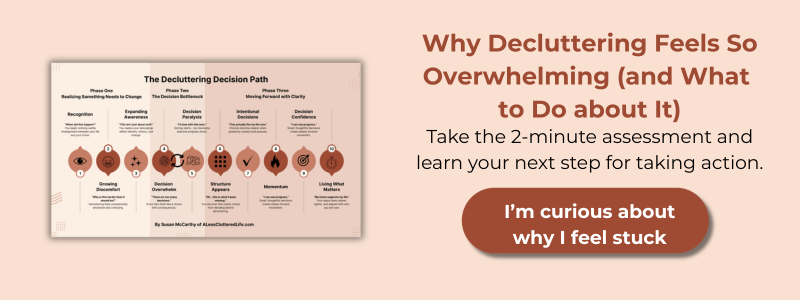
By Stage 9 in The Decluttering Decision Path, something begins shifting. Women often notice they aren't simply decluttering anymore. They're thinking differently. Shopping differently. Holding onto things differently. They're accumulating differently. Because confident decision makers start noticing clutter before it arrives.
Today's purchase becomes tomorrow's decision. And suddenly new questions appear:
Does this fit my life?
Do I realistically use things like this?
Is this connected to how I actually spend my time?
Not: Could I someday? Not: What if? Because possibility alone stops leading. Life begins leading.
Why Identity Makes Decluttering Harder
I think one of the strongest forms of clutter is identity clutter. Many of us keep things tied to earlier versions of ourselves. Past hobbies. Past interests. Past roles. Past possibilities. Not because they still fit. Because they once mattered.
Years ago, I taught art and craft classes for children. I loved creative projects and classes myself. Creativity mattered deeply to me. So, I kept supplies. Lots of them. Project materials. Ideas I might someday revisit.
I believed that keeping creative options available somehow supported my identity.
Because creative people try things. Creative people explore. Creative people have interests. So I kept all of it. But eventually I noticed something. When I looked honestly at how I actually spent my free time, I wasn't doing everything. And I didn't want to.
I naturally returned to card making. Crochet. Those were the things I genuinely used. Not because I stopped being creative. Not because I failed. Because my preferences became clearer. And eventually I realized:
Owning the supplies didn't make me creative. Using them did.
That changed everything. Because suddenly I wasn't preserving evidence of creativity. I was participating in it.
Life Leaves Clues
This is where many women get stuck. They think regret comes from letting go. But often regret comes from avoiding acknowledgment. Because life leaves clues. Retirement leaves clues. Your schedule leaves clues. Your habits leave clues. The books untouched on your shelf tell you something. The hobbies you haven't touched in years tell you something. The clothes hanging unworn tell you something.
Not because those things were mistakes. Not because you failed. Because life changes. And often you already know. You just haven't acknowledged it yet.
Ask Better Questions
Many women ask: "What if I need this someday?" But confident decision makers often ask different questions:
When will I use this?
How will I use this?
Those questions create context. Those questions create clarity. Those questions pull you back into your actual life rather than an imagined one. Because context changes everything. You're no longer evaluating an object. You're evaluating fit.
Confidence Isn't Certainty
This may be the biggest shift of all. Confident decision makers do not trust themselves because they're always right. They trust themselves because they know they can decide again.
They can: Try something. Change directions. Learn. Adjust. Realize something no longer fits. And choose differently.
That's confidence. Not certainty. Not perfection. Trust. And once you trust yourself, keeping things "just in case" starts losing its appeal. Because it no longer feels like security. It starts feeling like postponement.
Start Here
Choose one room you've already decluttered. Walk in. Pause. Look around. Ask:
Why do these things still belong here?
When will I use them?
How do they support the life I'm actively living?
And notice something else: Are there things that felt useful six months ago... that no longer fit? Not because you made a mistake. Because clarity grows. Because life changes. Because you changed. This is where postponing ends.
Recap of Confident Decision Makers and Decluttering
There's no guarantee that you won't regret decluttering anything. Our perspective on our possessions and our lives change. The decision wasn't a bad one when you made it. But more often, regret decreases when decisions are made based on real life instead of imagined future possibilities.
To regret the clutter from returning, stop focusing only on what leaves the house. Pay attention to the decisions that allow things in. This isn't about minimalism or deprivation. It's about choosing what genuinely belongs in your life now.


Comments