
Why Deciding Before Decluttering Changes Everything (And Makes It Easier)

Updated: Jun 1
Decluttering feels harder than it should because you may be starting in the wrong place. Learn why deciding before decluttering changes everything.


You decide it's finally time to declutter. Maybe the closet feels harder to manage. Maybe you're tired of moving things from one place to another. Maybe your home looks perfectly fine… but something feels off, so you tell yourself: "I'm going to declutter."
And you begin. You open a drawer. Walk into a room. Pull down a box. Then almost immediately the questions start. Do I keep this? What if I need it later? I spent good money on this. Maybe I should save it. What if I regret letting it go?
Suddenly something that seemed simple feels much harder than expected.
You know how to tidy. You know how to organize. So why does this feel so difficult?
Many women quietly arrive at the same conclusion: Something must be wrong with me. Maybe you tell yourself: I need more motivation. I need a full free weekend. I need to get in the right mindset. But what if the problem isn't you?
What if the problem isn't decluttering at all? What if you've simply been trying to make decisions without structure? Because that changes everything.
Why Decluttering Feels Overwhelming
Most people begin decluttering the same way: They start with the stuff. Touch an item. Make a decision. Move to the next thing. Repeat.
At first this feels reasonable. Until you realize what your brain is actually doing. You're making hundreds of tiny decisions. One item. One question. One possibility at a time.
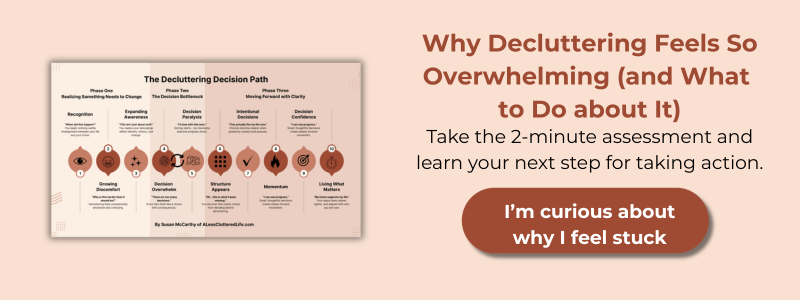
And every object comes with hidden questions attached to it: Will I need this? What did this cost? Who gave it to me? Could I use this someday? Am I wasting something? The mental weight builds slowly. Then all at once. Because the real problem was never the amount of belongings. The problem was trying to decide without first deciding where you're going.
Why Deciding First Changes Everything
Most decluttering advice starts by answering: "How can I clean this room?" I think there's a better question: What do I want this room to support?
Pause there for a minute. Because those are very different questions. Maybe you want more space to create scrapbook albums for your family. Maybe you want to entertain friends more often. Maybe you want to travel and spend less time maintaining a large home. Maybe you simply want daily life to feel lighter.
Those goals matter. Because goals create context. And context changes decisions. Once you understand where you're going, choices become easier.
Packing Your Suitcase for Vacation
Think about packing for a trip. You don't stand in front of an empty suitcase and start randomly throwing things inside. You don't pick up a sweater and ask: "Do I want this?" Then shoes. Then another shirt. Then a jacket.
No. You decide where you're going first. How long you'll stay. What kind of trip it is. What matters once you arrive. Then packing becomes easier. Because now you have context.
Decluttering works exactly the same way. Without a destination, everything feels equally important. With a destination, choices begin sorting themselves.
The Book Collection that I Thought Defined Me
I learned this lesson personally. When I first started working, I had a vision for my future. I loved reading. Still do. And I decided I was going to build a personal library. That felt sophisticated. Aspirational. Wonderful.
So, I bought books. Lots of books. I visited bookstores constantly. Joined mail-order book clubs. Bought fiction. Bought nonfiction. If I liked an author, I bought everything they wrote.
I imagined shelves filled wall-to-wall. There was only one problem. I lived in a bedroom. Not a house with a library. Eventually the books became difficult to manage. Books moved into boxes. Then more boxes. And once books live in boxes, something happens. You stop reading them. You can't see them. You forget what you own. You can't find what you want.
I realized I owned many books I had never even read. So gradually I started donating books. I stopped buying them automatically. I borrowed more from the library. And something unexpected happened. Library books came with due dates. Due dates meant I actually read them. No endless postponement. No "later."
And somewhere along the way I realized something important: My identity as a reader became stronger than my identity as a book collector. That changed everything. Because I wasn't deciding book by book anymore. I was deciding based on the life I actually wanted.
Sometimes We Aren't Preserving Identity
I think many women experience this in their homes. We believe we're preserving identity. Sometimes we're preserving evidence. Evidence of earlier versions of ourselves. Old hobbies. Past interests. Someday plans. Roles we used to have. Possibilities we never updated.
And when we don't decide first, every item feels equally important. Because every item becomes responsible for protecting a version of us we haven't fully reconsidered.
Deciding First Doesn't Mean Deciding What Leaves
This is important. When I say decide before decluttering, I don't mean: "Prepare yourself to let everything go." That isn't the goal. Deciding first isn't deciding what leaves. It's deciding what belongs. Very different.
You're not beginning with possessions. You're beginning with purpose. And purpose changes everything.
Start Here
Don't begin by sorting. Don't begin by pulling everything out. Choose one space. Or one corner of a room. A reading chair. A pantry. A desk. A crafting area. Then ask: What do I want this space to support? Not: What should I get rid of? Ask:
What benefit do I want from this space?
How do I want life to feel here?
What do I want this area to make easier?
Because this isn't really about decluttering. It's about decisions. Before you ever pick up an item, ask yourself: Would I pack this for the life I'm living now… or the life I'm working toward? That question changes things. Because confidence doesn't begin after decluttering. Confidence begins earlier. It begins the moment you stop reacting item by item and begin deciding intentionally.
Choose one space. Ask what you want from it. Start there. This is where postponing ends.
Recap on Deciding Before Decluttering
Deciding before decluttering means clarifying the life and function you want first so your decluttering decisions come more easily, made with intention.
If you find the act of decluttering emotionally exhausting, consider that's because you're trying to make decisions without context. Objects can represent money, memories, identity, and future possibilities and questions like, "Do I use this?" or "Should I keep this?" aren't the right questions for making decluttering decisions.
Limit those feelings of overwhelm by focusing on purpose before the possessions. Decide what you want your space to support before sorting items.
Also, the structure you get from deciding before decluttering helps create momentum without waiting around for motivation. The small actions you take based upon your decisions builds confidence. Confidence you won't gain by waiting for motivation.


Comments