
You Don’t Need a Perfect Day to Start Decluttering

Updated: Jun 1
Still waiting for the perfect time to start decluttering? Discover why motivation isn’t the first step - and the one small decision that helps midlife women stop postponing and finally move forward.


Something catches your attention. A closet feels harder to use. A shelf feels busier than it used to. You open a cabinet and wonder when it became so full.
Nothing dramatic happened. Your home still looks fine on the surface. But something feels off. And you think: "I really need to do something about this." Then you wait. You wait for a free weekend. You wait until life settles down. You wait until you feel motivated. You wait for the perfect day to start.
Most women assume this is normal. They believe motivation comes first. That once they finally feel ready, energized, and fully committed… then they’ll begin. But what if that isn't how it works?
What if movement comes first? Because recognition matters. Noticing matters. But noticing alone does not create change. And this may be one of the biggest reasons decluttering feels so difficult.
Recognition Can Feel Like Progress
There’s a stage many women enter long before they ever fill a donation box. They begin noticing. The crowded drawer. The cabinet they avoid opening. The room that somehow feels busier than it used to.
Awareness begins building. And awareness feels productive. Maybe you save articles. Read decluttering books. Watch videos. Mentally commit: "I really need to handle this."
Awareness matters. But awareness and movement are not the same thing. Sometimes postponed decisions disguise themselves as preparation. You tell yourself: "I’ll start after vacation." "I’ll begin once things settle down." "I need a full Saturday."
It sounds reasonable. And that’s what makes it so difficult to recognize. Because preparation feels responsible. But sometimes it quietly becomes delay. Weeks become months. Months become years. Not because you don’t care. Not because you’re lazy. Because you're waiting for conditions that feel safer. You're waiting to feel ready.
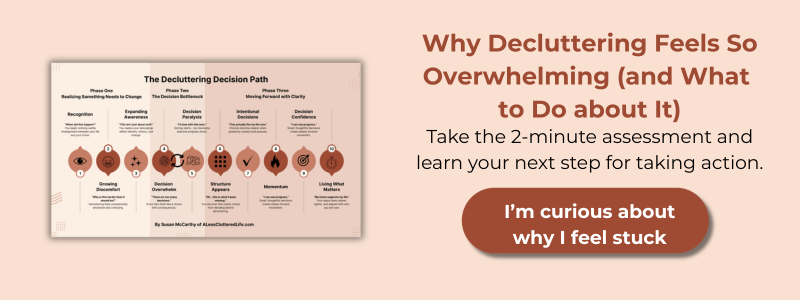
Why Decluttering Feels Harder Than You Expected
Many women become frustrated at this point. Because decluttering seems like it should be simple. You know what you use. You know what you don't. So why does each decision suddenly feel so weighted?
Because the challenge often isn't the belongings. The challenge is the decisions. This is where many women enter a stage I call Growing Discomfort: "Why is this harder than it should be?"
At first, it seems like a clutter problem. But eventually something deeper becomes visible. The hesitation.
The uncertainty. The quiet questions:
"What if I need this later?"
"What if I regret letting this go?"
"Shouldn't I keep this?"
Suddenly you're not sorting possessions. You're sorting possibilities.
The Day I Started Emptying My Parents' House
I knew my parents kept everything. Their home was a small ranch house and over time it had slowly become smaller. Boxes lined walls. Storage cabinets filled spaces that once felt open. Rooms felt crowded.
When I walked into that house intending to begin emptying it, I felt overwhelmed. But I also thought:
"This part should be easy" because clearly there were things they no longer needed. So, I got to work. I emptied medicine cabinet. Tossed expired supplies. Cleared the pantry cabinets. Emptied the freezer, old cleaning products, stained food containers.
I was productive. Very productive. But looking back, I can see something clearly now: I wasn't making important decisions. I was making easy decisions. Because nearby sat the books, kitchen items, boxes, decor. Things I suspected could probably go. But I hesitated.
And suddenly I found myself asking different questions:
"Why had they held onto this?"
"Did these things matter more?"
"Did they really intend to use them someday?"
Without realizing it, I had started postponing too. Not because I didn't know what to do. Because the decisions felt heavier.
The Problem with 'Someday'
Then something shifted. I realized my parents had held onto many things for someday. A someday that never came. And immediately I knew that I wasn't going to move postponed decisions into my own basement. That wasn't useful. That wasn't thoughtful. That was postponement.
And then another thought arrived: These things still had purpose. They could leave this house and become useful to someone else. Someone could use them. Enjoy them. Need them. And I felt immediate relief.
Not because the work became easy. Because the meaning changed. I stopped thinking: "This is clutter." And started thinking: "This still has purpose." The decisions didn't become easy. They became easier because I stopped trying to preserve postponed possibilities.
What Many Midlife Women Are Actually Protecting
I see women doing this every day. Not with a parent’s house. With their own belongings. They're waiting for certainty. Waiting until they know exactly where to start. Waiting until they feel fully prepared.
But often what they're protecting isn't usefulness. It's possibility. Past hobbies. Past identities. Future intentions. Versions of themselves they once expected to become. And slowly, quietly, someday becomes postponement.
Start Smaller Than You Think
You do not need to start in a room. You do not need to wait for an open a weekend. You do not need a complete plan. Start with one item. Pick something up and ask: Is this supporting the life I’m living right now?
Is it helping your life function? Is it making life more enjoyable? That's all. No pressure. No dramatic decision. You may realize: "Yes." "I use this." "This matters."
That counts. Because now you're learning something important. You’re identifying what belongs. And if you genuinely don't know? Choose something else. Keep gathering information. Keep noticing. Keep deciding. Because clarity creates movement.
And movement creates confidence.
This Is Where Postponing Ends
You do not need motivation. You do not need perfect conditions. You need one decision. One question. One moment of noticing that turns into movement. Because your home has been telling a story for a long time. You're simply beginning to listen.
Recap on How to Start Decluttering
If you've been putting off decluttering, know that this isn't a sign of laziness or lack of discipline. It's postponed decision-making. You're waiting for certainty, motivation, or ideal conditions that may never arrive.
You may even hope that you'll feel less emotional about decluttering if you can figure out the best conditions under which to sort things. Because belongings often represent identity, expectations, memories, and future possibilities - not just objects, you will always feel emotions when you declutter.
So, even if you feel overwhelmed, start with one item and one question: "Is this supporting the life I’m living right now?" One decision creates movement. Movement creates confidence.


Comments