
Decision Overwhelm: How to Reduce Decision Fatigue Before You Start Decluttering

Feeling overwhelmed by decluttering? Learn how decision fatigue—not lack of motivation—may be keeping you stuck and discover a simple way to reduce decision overwhelm and start making progress.


You may not be tired of decluttering. You may be tired of thinking about decluttering.
There's a difference.
Many women tell me they don't have the energy to declutter. They look around their homes and immediately feel overwhelmed. The closet needs attention. The guest room is full. The garage has become a holding place for unfinished projects. There are books you haven't read, hobby supplies you haven't touched, inherited belongings you aren't sure what to do with, and quality items you spent good money on.
When you look at all of it, decluttering feels exhausting before you've even begun.
So, you wait.
Maybe after the holidays. Maybe next month. Maybe when life settles down. Maybe when you feel more motivated. But what if the problem isn't a lack of energy? What if you're exhausting yourself before you ever start?
The Hidden Weight of Future Decisions
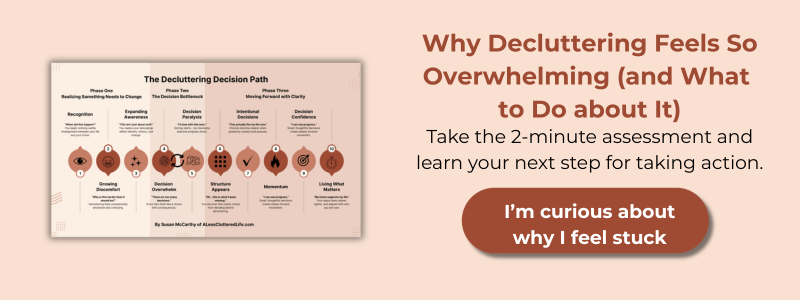
One of the most common stages women experience on the Decluttering Decision Path is Decision Overwhelm.
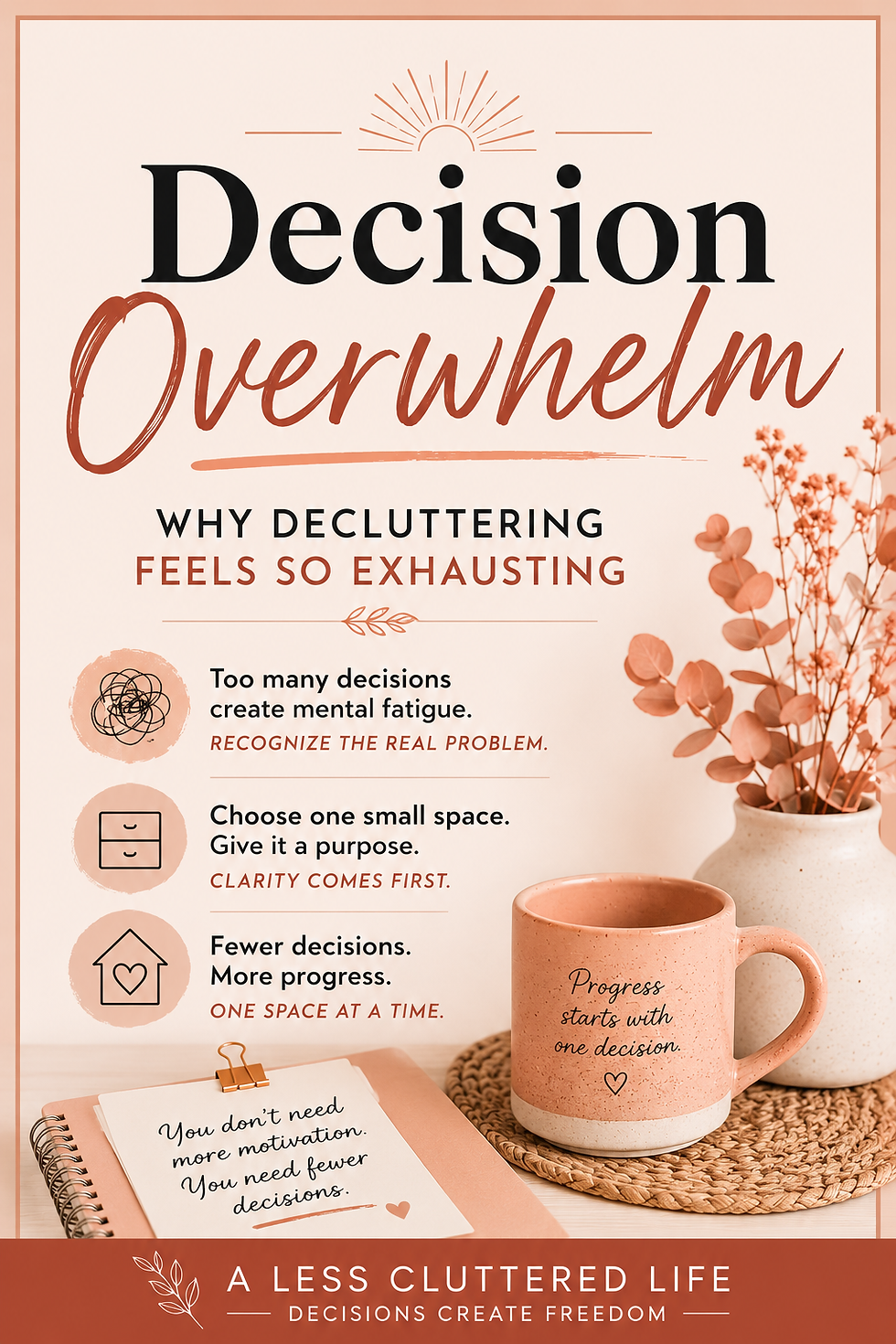
At this stage, the problem isn't necessarily the amount of stuff. The problem is the number of decisions attached to the stuff. Without realizing it, many women start trying to solve their entire house at once.
The questions begin stacking up:
Where do I start?
How long will this take?
What if I need something later?
What if I regret letting it go?
What about the money I spent?
What about the things that belonged to my parents?
What if I make the wrong decision?
What if I get halfway through and quit?
Each question feels reasonable on its own. Together, they create mental overload. By the time you've mentally worked through every room, every category, and every possible future outcome, you're exhausted.
Not because you've done any decluttering. Because you've been carrying hundreds of future decisions around in your head. The overwhelm often isn't coming from the work itself. It's coming from the anticipation of the work.
Why More Time Doesn't Solve the Problem
When women feel overwhelmed, they often assume they need more motivation. They tell themselves they'll tackle decluttering when they have more energy or a larger block of time. The problem is that waiting doesn't reduce decision overload.
If looking at your entire house feels overwhelming today, it will probably feel overwhelming next month too. The house hasn't changed. The decisions haven't changed. The mental burden hasn't changed.
Time alone rarely solves a structural problem. That's why so many women find themselves postponing the same project year after year. They aren't avoiding decluttering. They're avoiding the weight of all the decisions they believe they'll have to make.

A Lesson from a Filing Cabinet
Years ago, I worked with a client who owned several rental properties with her husband. Their business generated a tremendous amount of paperwork. For years, I met with her in person and helped organize documents into files. Then the pandemic arrived. Our in-person meetings stopped. The papers kept coming.
Over time, stacks of paperwork accumulated throughout her home. When we began meeting virtually, she seemed overwhelmed by the volume. But the amount of paper wasn't actually the problem. The problem was the filing system.
She had developed an extremely detailed system with multiple categories, subcategories, and individual folders for specific expenses. A single document required several decisions: Which property? Which category? Does this need a new file? Should a subfolder be created? Where exactly does this belong?
Every paper carried too much mental weight. What finally helped wasn't more time. It wasn't working harder. It wasn't waiting until she felt motivated. We simplified the system. Instead of creating endless categories, we grouped documents into broader files. Would it occasionally take an extra minute to find something? Maybe.
But filing became dramatically easier. Not because there were fewer papers. Because there were fewer decisions.
That's an important distinction. Sometimes overwhelm isn't caused by the amount of stuff. It's caused by the number of decisions you've attached to the stuff.
Why Starting Small Works
You'll often hear decluttering advice that says: "Start small." I agree. But perhaps not for the reason most people think.
Many people assume starting small works because the task itself becomes easier. I think it works because the decisions become easier. When you look at your entire house, you're facing hundreds or thousands of decisions. When you look at one drawer, you're facing a handful.
That's a very different experience. This is why I teach the concept of Linked Little Spaces. A Linked Little Space is a small, clearly defined area that can be completed in a relatively short period of time.
A drawer.
A shelf.
A cabinet.
A small section of a closet.
The power isn't that the space is small. The power is that the number of decisions is contained. You stop trying to solve your entire house and focus on one manageable set of choices.
Decide Before You Declutter
There's another step that makes the process even easier. Before you begin decluttering a space, decide what the space is for. This may seem simple, but it changes everything.
Imagine you're working on a dresser drawer. Before touching anything inside, decide: This is my sweater drawer. Now the drawer has a purpose. That purpose becomes a filter. Sweaters belong. T-shirts do not. If sweaters are scattered elsewhere in the house, you can gather them. If there are too many sweaters to fit comfortably, you can decide which ones best support the purpose of the space.
Notice what happened. You didn't start by evaluating every item. You started by defining the role of the space. That single decision eliminated dozens of future decisions. The clarity came first. The decluttering came second.
The Real Goal
Many women believe they need more motivation before they can begin. I don't think motivation is the missing piece. Structure is. When decisions feel overwhelming, motivation struggles to overcome the resistance. When decisions become manageable, action becomes possible.
That's why confidence isn't built through inspiration. It's built through making decisions and following through on them. One decision leads to another. Progress becomes visible. Momentum begins to grow. Not because you finally felt motivated. Because you created enough structure to move forward.
Start Here
If you've been postponing decluttering because it feels overwhelming, try this instead. Choose one Linked Little Space. One drawer. One shelf. One small section of a closet.
Before touching anything, decide how you want that space to support your life. Give it a purpose. Then focus only on that space. Not the entire house. Not every future decision. Just that one area.
Maybe your first step is simply emptying the drawer. That's enough. Once the contents are out, you'll often find yourself naturally returning the things that belong there. Because now you're not managing an entire house. You're making a small number of decisions inside a clearly defined space.
And that feels different. The goal isn't to think smaller because you're incapable of handling something larger. The goal is to create enough structure that your decisions become manageable. Because when decision fatigue decreases, action becomes possible.
Choose one space. Decide what it's for. Start there. This is where postponing ends.
Recap on Decision Overwhelm and Decision Fatigue
Decision overwhelm occurs when the number of choices feels larger than your ability to process them. In decluttering, this often happens when you try to think about your entire house at once rather than focusing on a single space.
For many women, the exhaustion comes before the decluttering begins. The mental burden of future decisions - what to keep, what to let go of, what you might need later - creates fatigue before any physical work happens.
To reduce decision fatigue when decluttering, reduce the number of decisions you're making at one time. Work in a small, defined space and decide the purpose of that space before evaluating the items inside it.
I call those small, defined spaces Linked Little Spaces. A Linked Little Space is a small, clearly defined area that can be completed in a short period of time, such as a drawer, shelf, cabinet, or section of a closet. It helps contain the number of decisions you're making and creates visible progress.


Comments