
Future Clarity Is a Myth: Why Waiting Rarely Makes Decluttering Decisions Easier

Are you waiting for clarity before decluttering? Discover why future clarity is often a myth, how decision paralysis keeps you stuck, and how to make confident decluttering decisions without waiting for certainty.


Most women don't postpone decluttering because they lack motivation. They postpone because they're waiting for clarity.
They pick up an item and think: "I'll decide later." At first, it sounds reasonable. Responsible, even. After all, not every decision needs to be made immediately. Some deserve thought. Some deserve reflection. The problem is that "later" has a way of stretching far beyond what we intended.
Tomorrow becomes next week. Next week becomes next month. And before long, the item is still sitting there, waiting for a decision that never seems to arrive.
What I've noticed over the years is that many women aren't actually waiting for more information. They're waiting for certainty. And those are not the same thing.
The Assumption Behind "I'll Decide Later"
When we postpone a decision, we often tell ourselves a simple story: "I just need more time." More time to think. More time to reflect. More time to figure out what feels right.
But if we're honest, many of the facts are already available. You know how long it's been since you've used the item. You know whether it supports your current life. You know whether you've been moving it from place to place for years. You know whether you've already questioned keeping it. The information often isn't missing.
What feels missing is certainty. We want the decision to feel obvious. We want all the doubts to disappear. We want to know with complete confidence that we're making the right choice. So, we wait.
And underneath that waiting is a belief we rarely say out loud: "My future self will know something I don't know today." That belief feels comforting. But it creates one of the biggest forms of decision paralysis I see.
The Three Versions of You
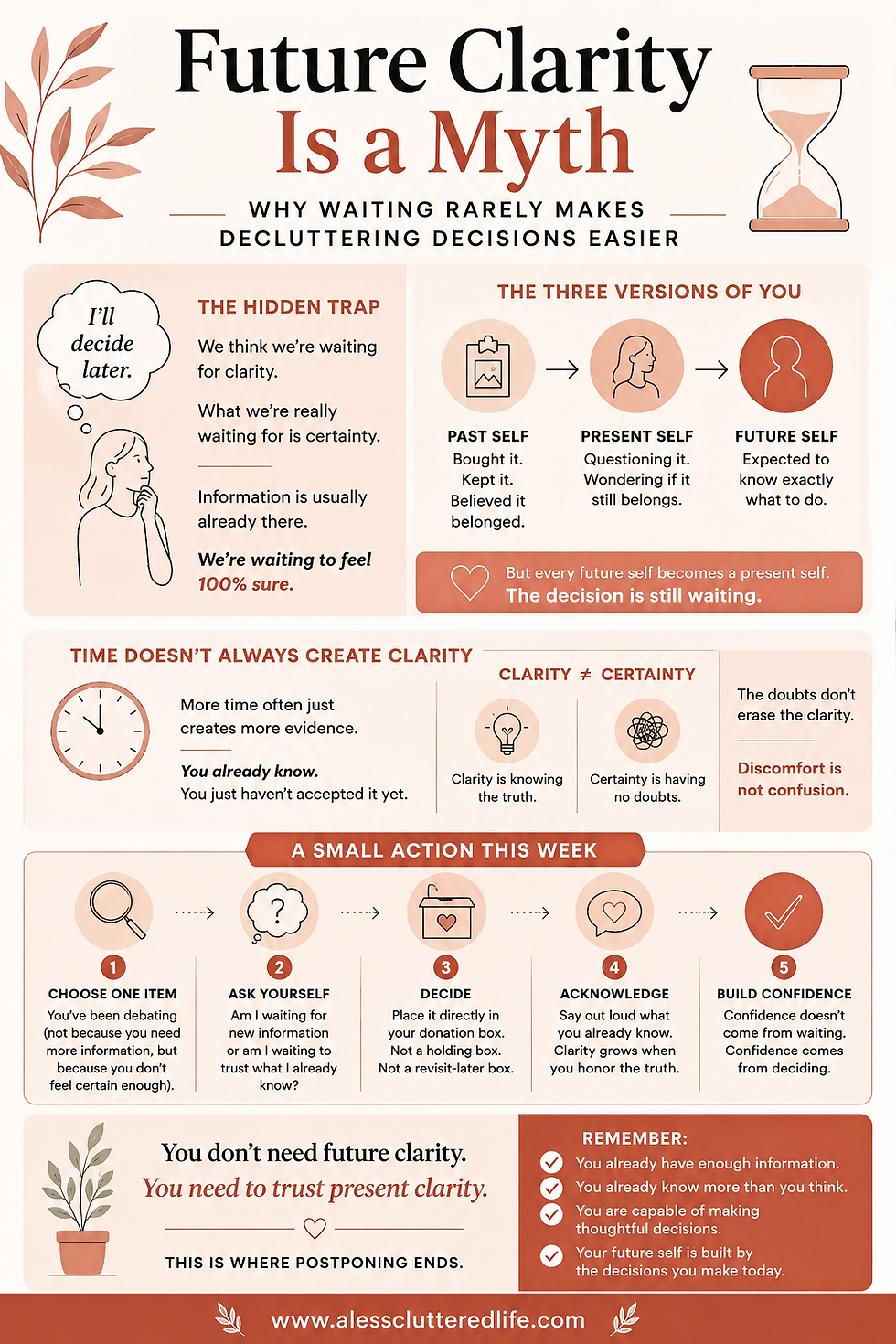
When women get stuck with a difficult decluttering decision, they're often caught between three versions of themselves. First, there's Past Self. She's the one who bought the item. Saved the item. Stored the item. Believed it belonged in her life.
Then there's Present Self. She's standing there holding it. Questioning it. Wondering whether it still belongs. And because she's not completely sure whether Past Self was right or Present Self is right, she hands authority to a third person. Future Self.
Future Self feels wiser. More confident. Less emotional. Less likely to make mistakes. Future Self will know exactly what to do. At least that's what we tell ourselves. But here's the problem. Future Self doesn't actually exist. Not yet.
And every future self eventually becomes a present self. You don't wake up one morning magically equipped with perfect answers. You wake up as yourself. Standing in another version of today. Holding the same decision. The future self you've been waiting for never really arrives. Because every day is still today.
Why Time Doesn't Always Create Clarity
One of the biggest misconceptions about decluttering is that time automatically creates clarity. Sometimes it does. But often it simply creates more evidence. You already knew six months ago that you hadn't used the item in six months. Now another year has passed. You still haven't used it. The evidence has increased.
But the core truth hasn't necessarily changed. Many women eventually make a decluttering decision based on information they already had months—or even years—earlier. The difference isn't that they learned something new. The difference is that they're finally willing to trust what they already knew.
And that's why waiting can be deceptive. It feels productive. It feels thoughtful. It feels responsible. But sometimes it's simply postponing a conclusion you've already reached.
The Photo Album Lesson
I learned this lesson myself through a collection of vacation photo albums. Growing up, my family didn't take the kind of vacations where you traveled somewhere and stayed for a week. So, when I became an adult and started traveling, I took photographs everywhere I went.
After each trip, I printed the photos. I carefully selected which ones to include. I organized them into albums. I labeled them. I preserved them.
At the time, those albums felt important. There was money invested. Time invested. Effort invested. For years, I never questioned keeping them. Then something changed.
After one trip, I didn't print the photos. The pictures stayed on my computer. No album was created. And a question quietly surfaced. Do I really need these photo albums?
I knew I never looked through them. I knew the photos still existed digitally. I knew I wasn't making new albums anymore. But instead of making a decision, I told myself something familiar. "I should look through them one last time."
So, I placed the albums beside a chair. A chair I walked past every day. The plan seemed simple. The next time I sat down, I'd go through them. But weeks passed. The albums remained untouched. Every day I had the opportunity. Every day I walked by. Every day I chose not to pick them up.
Eventually, I acknowledged something I had known all along. Looking through old vacation photo albums simply wasn't important to me anymore. The memories still existed. The photographs still existed.
But the albums themselves no longer served a purpose in my life.
What strikes me now is that I wasn't lacking information. I already knew the answer. The facts hadn't changed. The only thing that changed was my willingness to accept what those facts were telling me.
Clarity Is Not the Same Thing as Certainty
This may be one of the most important distinctions in the entire decluttering process. Many women confuse clarity with certainty. They imagine clarity as a feeling. A moment when every doubt disappears. A moment when the answer feels obvious. A moment when they're completely confident.
But real-life clarity doesn't always feel that way. Sometimes clarity sounds like: "I haven't used this in years." And then doubt immediately responds: "But what if I need it someday?" Or: "What if I regret letting it go?" Or: "What if someone asks for it?"
The doubts are loud. The doubts are persuasive. But they don't erase the original truth. The fact that you haven't used it remains true. The fact that it no longer supports your current life remains true. The fact that you've been questioning it remains true.
The discomfort doesn't cancel the clarity. It simply makes the decision harder to accept. And that's an important distinction. Discomfort is not confusion. Many women are waiting for a level of certainty that simply doesn't exist. They're waiting for every doubt to disappear. Every possibility to be resolved. Every future scenario to be answered.
But most meaningful decisions don't work that way. Clarity can coexist with uncertainty. Clarity can coexist with hesitation. Clarity can coexist with fear. And it is still clarity. In fact, I've come to believe this: Future clarity is often just present clarity that hasn't been accepted yet.
Not always. But often.
Why This Matters Beyond Decluttering
At first glance, this might sound like a conversation about stuff. But it isn't really about stuff. It's about trust. It's about learning to trust your own judgment.
Many women arrive at this stage of life carrying decades of postponed decisions. Projects they'll probably never finish. Items they feel obligated to keep. Possibilities that no longer fit who they are today.
The real work isn't simply deciding what leaves the house. The real work is rebuilding confidence in your ability to decide. Because every thoughtful decision becomes evidence. Evidence that you can trust yourself. Evidence that you don't need perfect certainty. Evidence that you can move forward without knowing every possible outcome.
That's how decision confidence is built. Not through waiting. Through deciding.
One Small Action This Week
Choose one item you've been debating. Not because you need more information. Because you don't feel certain enough. Choose something where part of you already knows the answer.
Maybe you haven't used it in years. Maybe you no longer enjoy it. Maybe it belongs to a version of your life that no longer exists. Place it directly into your donation box. Not a holding box. Not a revisit-later box. Your actual donation box.
Then acknowledge what you already know. You might say: "I haven't used this in a long time." "I don't realistically see myself using it again." "I don't need more time to reach the conclusion I've already reached."
Use whatever words feel true. The wording isn't important. The honesty is. Because confidence doesn't come from waiting. Confidence comes from deciding.
Decluttering Decisions and Clarity
The next time you catch yourself saying: "I'll decide later." Pause. Ask yourself one simple question: Am I waiting for new information? Or am I waiting to trust what I already know? Those are very different situations.
And your answer may reveal that the clarity you've been waiting for has been with you all along. This is where postponing ends.



Comments