
Why Decision-Making Is the Missing Piece in Decluttering



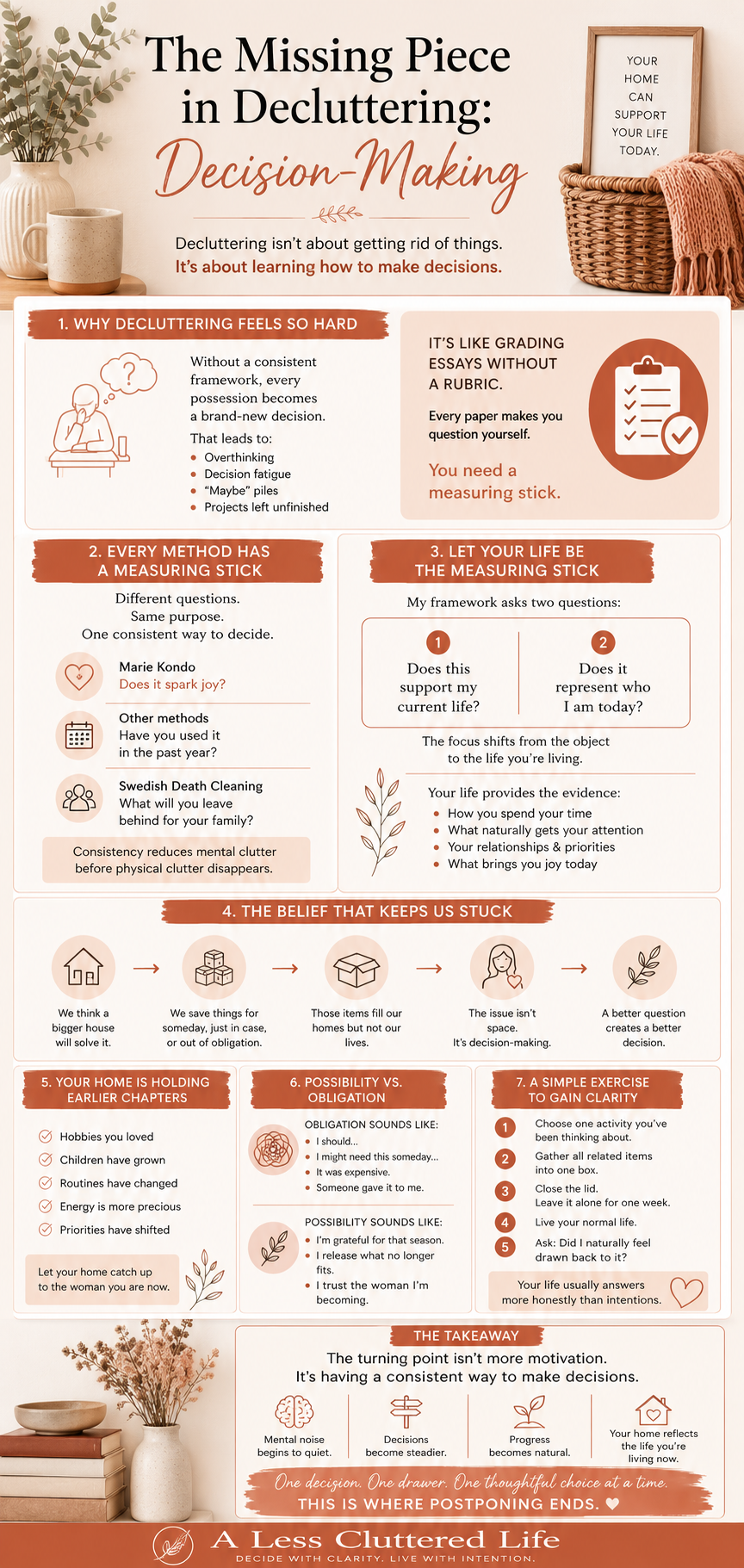
Most women think decluttering is about getting rid of things. I don't. I believe it's about learning how to make decisions.
That's an important distinction because it explains why so many intelligent, capable women feel stuck. They aren't struggling because they don't know how to organize a closet or fill a donation box. They're struggling because every possession feels like a brand-new decision.
One sweater raises questions about money spent. A stack of books reminds you of the woman who planned to read more. Craft supplies whisper about hobbies you once loved. Inherited belongings carry memories that seem impossible to sort through.
Every item asks a different question. No wonder decluttering feels exhausting. The problem isn't your home. The problem is that you've never been given a consistent way to evaluate what belongs in your life now. That changes everything.
Why Decluttering Feels So Mentally Exhausting
Imagine a teacher grading essays without a grading rubric. She reads the first paper and wonders if she's being too generous. She reads the second and questions whether she's now being too strict. Every paper feels uncertain because there's no standard against which to judge it.
Decluttering works the same way. Without a decision framework, every possession becomes an isolated decision.
You ask yourself:
What if I need this?
What if I regret donating it?
It was expensive.
Someone gave it to me.
Maybe someday...
Instead of making progress, you're constantly creating new rules. That mental work is exhausting. It's why so many women stop halfway through a decluttering project, create "maybe" piles, or simply close the closet door and promise themselves they'll deal with it another day.

Every Decluttering Method Uses a Measuring Stick
Over the years, many decluttering experts have introduced different approaches. Marie Kondo asks whether something sparks joy. Other methods suggest asking if you've used an item within the past year. Swedish Death Cleaning encourages you to consider what you'll leave behind for your family.
These questions are very different. But they all accomplish the same thing. They give you one consistent measuring stick. Instead of inventing a new way to judge every possession, you simply apply the same framework repeatedly. That consistency reduces mental clutter long before physical clutter begins to disappear.
Let Your Life Become the Measuring Stick for Decluttering Decision-Making
My own decision framework asks two questions:
Does this support my current life?
Does it represent who I am today?
Those questions completely shift your attention. Instead of studying an object and trying to predict the future, you begin by looking at your life.
How do you actually spend your time? What naturally receives your attention? Which relationships, interests, and activities fill your days?
Your current life becomes the evidence. The possession is no longer making its own argument. Your life has already answered the question. That is where clarity begins.
The Belief That Quietly Keeps So Many Women Stuck
For years, I believed the answer to clutter was a larger house. Growing up, our home was full. My mother often said, "If we had a bigger house, we'd have enough room for all our things." It sounded perfectly logical.
I carried that belief into adulthood. I loved books. Craft supplies. Projects I'd return to someday. I assumed more space would solve the problem. Then I emptied my parents' home. Room after room contained perfectly good belongings that had been carefully saved for years. Many had never been used again.
That experience changed my thinking forever. A bigger house would have made those possessions look less crowded. It wouldn't have made them more useful. It wouldn't have created more time. It wouldn't have finished abandoned projects. The issue wasn't square footage. The issue was the decision-making framework.
I stopped asking, "Will I have room for this?" Instead I began asking, "Does this belong in the life I'm living now?" That single question transformed my decluttering decision-making.
Your Home Is Holding Earlier Chapters
One of the most meaningful discoveries women make while decluttering is that their home often reflects lives they've already outgrown. Children have grown up. Retirement has changed daily routines. Interests have shifted. Energy is more precious. Priorities have changed. Yet many homes still preserve earlier versions of ourselves.
The quilting supplies. The sewing room. The exercise equipment. The stacks of books we'll read "someday." These aren't simply belongings. They're reminders of possibilities. And that's why letting go feels so difficult.
We're rarely deciding between something good and something bad. We're often deciding between who we were and who we are now.
You're Not Reinventing Yourself
Midlife is often described as a time to reinvent yourself. I see it differently. I don't think most women need reinvention. I think they need recognition.
Your everyday life has already been quietly telling you who you've become. Look at your calendar. Notice where your energy naturally flows. Pay attention to what brings you joy today - not twenty years ago. Without making any formal announcement, your life has already changed. Decluttering simply allows your home to catch up.
The Difference Between Possibility and Obligation
Many women believe letting go means closing the door forever. I don't think that's true. I think the real difference is this: Keeping something often preserves obligation - not possibility.
Every unfinished project quietly asks, "When are you coming back?" Every abandoned hobby whispers, "You really should..." Those conversations happen every time you walk past them.
They're emotionally heavy because they remain unanswered. When you recognize that a season has naturally ended, something changes. You stop feeling guilty. You begin feeling grateful. You appreciate what that chapter gave you without believing you must carry it into every future chapter of your life. That shift is incredibly freeing.
A Simple Exercise
Choose one activity you've quietly been thinking about while reading this. Perhaps it's knitting. Painting. Scrapbooking. Golf. Sewing. Gather every item connected to that activity into one box. Not to donate. Not to keep. Simply to gather one story into one place.
Close the lid. Then leave it alone for one week. Go live your normal life. At the end of the week, ask yourself one question: Did I naturally feel drawn back to this activity? Not, "Should I?" Simply, "Did I?" Your life usually answers that question more honestly than your intentions ever can.
The Freedom That Comes from Structure
The turning point in decluttering isn't finding more motivation. It isn't buying better storage containers. It isn't waiting for the perfect weekend. The turning point is having a consistent way to make decisions.
Once your current life becomes your measuring stick, the mental noise begins to quiet. Decisions become steadier. Progress becomes more natural. Your home gradually reflects the woman you already are instead of preserving every possibility you've ever imagined.
That's what real decluttering offers. Not a perfectly organized house. A home that supports your life today. One decision. One drawer. One thoughtful choice at a time. This is where postponing ends.


Comments