
Why They Don’t See the Clutter (And What Actually Helps Them Notice)

Struggling with a spouse or parent who won’t declutter? Learn why they don’t see clutter—and how to gently help them recognize when possessions no longer support their life.


There’s a frustrating moment that happens in many homes. You look around and see too much stuff. They look around and see… perfectly good possessions. Nothing looks broken to them. (Or they’re planning to fix it.) Nothing feels excessive.
And that’s what makes this so hard. Because you’re trying to solve a problem they don’t believe exists.
They Don’t See Clutter… They See Value
When someone holds onto things because they might be useful someday, they’re not being careless. They’re being thoughtful. Responsible. Prepared. They believe that decluttering is about indiscriminately getting rid of things as opposed to making thoughtful choices.
In their mind, those items represent:
Money that shouldn’t be wasted
Resources that could be useful
A way to avoid regret later
So, when you point out things that you see as clutter, they think you want them to toss all their possessions in the trash. Keeping these things means that they’re making poor decisions. And without meaning to, you’ve stepped into a disagreement that has nothing to do with the item itself.
This Is Why You Feel Stuck
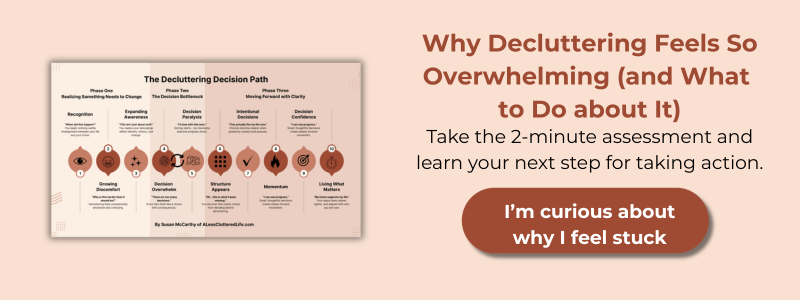
Most advice focuses on how to declutter. But that assumes something important has already happened: Recognition. In the Decluttering Decision Path, this is Stage 1. It’s the moment when someone sees: “Something here isn’t working anymore.”
If that moment hasn’t happened… There is no decision to make. There is no motivation to change. There is no decluttering process to begin. Because from their perspective, everything still makes sense. They don't see clutter.
A Moment I’ll Never Forget
I saw this clearly when I offered to clean my parents’ basement as a gift for a milestone anniversary. My mother couldn’t go up and down the stairs anymore, so she gave me one condition: I had to show her every single item I wanted to get rid of. Every item.
I brought upstairs a broken badminton set. The racquets held together with tape. The shuttlecock, split. Holes in the net tied shut with matted knots. My mother looked at it and told me to keep it because the grandchildren could play with it someday.
But neither my brother nor I had children. My mother imagined grandchildren. What bothered me about her comment was that she envisioned my children visiting and happily playing with broken toys.
From her perspective, nothing in that basement was clutter. It was all still potential. And in that moment, I realized something important: I wasn’t helping her declutter. I was asking her to let go of things she still believed had a place in her life.
You Can’t Convince Them… But You Can Help Them See
This is the shift that changes everything. You cannot argue someone into seeing clutter. But you can help them notice where their home is no longer supporting their life. And that’s where Stage 1 begins.
Not with sorting. Not with donation boxes. But with a quiet realization: “This isn’t working as well as it could.”
What Actually Helps Someone Recognize the Problem
If you want to help a spouse or parent move forward, you don’t start with decluttering. (Or even mentioning decluttering, which they likely equate with, “You want me to throw out all my stuff.”)
You start with awareness. Here are a few gentle ways to support that shift…
1. Ask Questions That Invite Reflection
Instead of pointing out the clutter, draw attention to their experience.
“How easy is it to find things in here?”
“Does this space feel like it’s working for you?”
“Do you use everything that’s in this cabinet?”
You’re not telling them anything. You’re helping them notice.
2. Connect to Moments of Frustration
Change doesn’t happen because something makes sense. It happens because something feels inconvenient… or difficult.
When they:
Can’t find something.
Feel overwhelmed in a space.
Get frustrated with a task.
Gently connect the dots:
“I wonder if having fewer things here would make that easier.”
“Do you think the amount of stuff might be part of that?”
You’re not blaming. You’re offering a possibility.
3. Talk About Function, Not Stuff
This is one of the most effective shifts you can make. Instead of focusing on what they have, focus on what they want to do.
“It would be nice to have a cleared space to work on your projects.”
“It might feel easier to cook if the counters were clearer.”
“I know you like reading here… what would make this space more comfortable?”
You’re moving the conversation away from items and toward life.
4. Let Your Own Experience Speak
When you make decisions about your own things and experience the benefits… share that casually.
“It’s been so much easier to find things since I cleared the kitchen gadget drawer.”
“I realized I wasn’t using most of that, and I don’t miss it.”
You’re showing that letting go is safe. And often… freeing.
What You’re Really Doing
You’re not trying to get them to declutter. You’re helping them see where their possessions might not be supporting their life anymore. Because once they see that… everything changes.
That’s when they step onto the Decluttering Decision Path. That’s when decisions become possible.
A Gentle Next Step
If you’re feeling frustrated right now, take a breath. You don’t have to fix everything. You don’t have to convince them. Just choose one small approach:
Ask one thoughtful question
Reflect one moment of frustration
Point out one way a space could better support their life
And let that be enough. Because recognition doesn’t happen all at once. It happens in small, quiet moments of noticing.
Want Help with What Comes Next?
Once someone begins to recognize that something isn’t working, the next question becomes: “Now what?” That’s exactly what I help you with.
If you’d like gentle guidance on how to make clear, confident decisions without overwhelm or second-guessing… I’d love to support you. Take the Decluttering Decision Path assessment and join my email list. I’ll send you practical steps, encouraging insights, and simple ways to move forward… wherever you are on the Path... one thoughtful decision at a time.




Comments