
Knowing How to Declutter Isn't the Same as Knowing What to Keep

Why does decluttering suddenly feel so hard? Discover why knowing how to declutter isn't the same as knowing what to keep—and how to make confident decisions.

Most women don't get stuck because they don't know how to declutter. They get stuck because they reach a point where the decisions stop being obvious.
The junk mail goes in the recycling without hesitation. The expired medications are easy to throw away. The broken kitchen gadget you've already replaced? No problem. At first, decluttering feels surprisingly manageable. Then you open a cabinet filled with serving dishes.
Or scan the books on your shelves. Or look around the sewing room. Or notice the craft supplies you've carefully saved. Or find yourself facing the boxes tucked away in the attic.
Suddenly, you're holding something you haven't used in years, wondering why making one decision feels so difficult.
If you've ever experienced that shift, you're not alone. And you're not bad at decluttering. You've simply reached a different kind of decision.
Why Decluttering Suddenly Feels Hard
Many of us have spent years collecting decluttering advice. We've heard the rules.
If you haven't used it in a year, let it go.
If it's broken, throw it away.
If you have duplicates, keep the best one.
Those guidelines work well when the decision is obvious. But eventually you reach possessions that aren't broken, expired, or unnecessary. They're simply connected to another season of your life.
That's where many women become frustrated. "I know how to declutter." "So why can't I decide?"
The answer is surprisingly simple. Knowing how to declutter isn't the same as knowing what belongs in your life now.
You're Not Struggling with Decluttering... You're Struggling with Decisions
This is an important distinction. Much of the decluttering advice available today asks one question: What should you get rid of? Very little attention is given to the other side of the decision-making process: What deserves to stay?
At first, those questions seem identical. They aren't.
When your focus stays on getting rid of things, every possession begins to feel like something you must defend. You find yourself saying:
"I might use it someday."
"It was expensive."
"My daughter may want it."
"I always meant to finish that project."
Notice what happened. You stopped evaluating your life. You started defending the object. Those are completely different conversations. The first leads to clarity. The second often leads to postponement.
The Lesson I Learned While Clearing My Parents' Home
I experienced this firsthand while emptying my parents' house. Both of my parents had hoarding tendencies. Their small home was filled with narrow pathways winding through every room. There were stacks of books, years of magazines, expired medications, old cleaning supplies, clothing that hadn't been worn in years, and countless everyday items that reality had already decided were no longer useful.
Those decisions weren't especially difficult. Then I climbed into the attic. There I found carefully packed boxes filled with dishes, tea sets, serving trays, vases, and family belongings that had likely come from my grandparents' homes years earlier.
Those boxes made me stop. Not because I couldn't identify what they were. Because I couldn't identify what they meant. Had these pieces been treasured? Were they saved out of obligation? Were they intended for future family gatherings that never happened? Or had they simply been my parents' postponed decisions? I had no way of knowing.
The surprising part was this: Because I hadn't grown up using those items (or even knowing they existed), they didn't feel sentimental. They felt like the beautiful pieces you might admire while walking through an antique store.
Interesting. Sometimes lovely. But not something I wanted to build my own life around.
That experience changed how I think about decluttering. It wasn't really about the dishes. It was about deciding what belonged in my life.

Your Home Is Telling the Story of Your Life
Our belongings aren't random. They tell the story of where we've invested our time, energy, and attention.
They reflect:
Hobbies we've enjoyed.
Careers we've built.
Children we've raised.
Friends we've welcomed around our table.
Skills we've learned.
Dreams we've pursued.
Sometimes they also reflect dreams we've quietly outgrown. That's often where the discomfort begins. Not because you're making a mistake. Because you're recognizing that your life has changed. The woman you were twenty years ago isn't the woman you are today.
That doesn't diminish your earlier seasons. It simply acknowledges that you're living a different chapter now.
A Better Question to Ask
One of the most common decluttering questions is: "When did I last use this?" While that question has its place, I think there's a better one. "What does my life actually look like today?" That question changes everything.
Instead of evaluating one object at a time, you begin with the bigger picture. How do you spend your days? Do you:
Work?
Volunteer?
Care for grandchildren?
Care for aging parents?
Garden?
Read?
Travel?
Quilt?
Sew?
Paint?
Walk every morning?
Meet friends for coffee?
Host family dinners?
Your answers reveal something important. They show you what your home needs to support. Once you're clear about your life, many decisions become surprisingly straightforward.
Try This Before Your Next Decluttering Session
Before you begin sorting another drawer or closet, take a few minutes to complete this exercise. On a sheet of paper, write down the activities that genuinely make up your life today. Leave space beneath each one.
Now list the categories of belongings that support those activities. For example: If you enjoy gardening, you'll naturally have gardening tools and supplies. If you regularly host family dinners, serving dishes and table linens probably still have an active purpose. If you love to sew, your sewing machine and fabric aren't simply stored possessions, they support a meaningful part of your life.
The goal isn't to inventory everything you own. The goal is to begin with your life instead of your belongings. That's a very different starting point.
This Is the Moment Everything Begins to Change
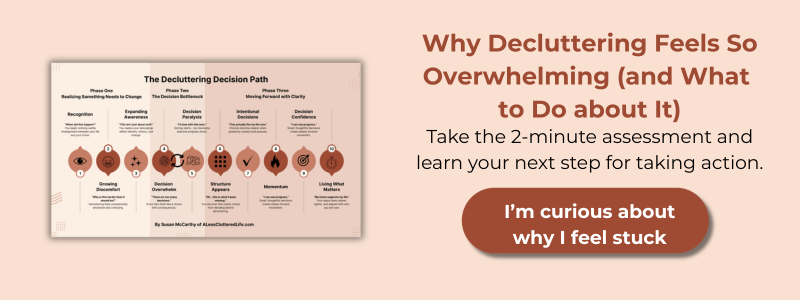
I call this stage Growing Discomfort. It's the point where you realize that another decluttering checklist isn't what you need. You don't need another rule. You need a way to make decisions that reflects the life you're living now.
That's where clarity begins. Not with the stuff. With you. Because when you understand the life you're living today, it becomes much easier to recognize what belongs in it.
Your home doesn't need to preserve every version of yourself you've ever been. It only needs to support the woman you are today.
What to Keep When Decluttering
If decluttering has suddenly become harder than you expected, don't assume you're failing. You may simply be standing at the threshold between following decluttering rules and making intentional decisions.
That's an important place to be. It's where confidence begins to replace hesitation. One thoughtful decision at a time.
Because your home isn't asking you to be perfect. It's simply asking you to decide what belongs in the life you're living now. And that's where postponing ends.



Comments